Gay Marriage | Gay Rights | Maryland | News

Best gay blog. Towleroad Wins Award

09/18/2007


Maryland High Court Upholds Gay Marriage Ban

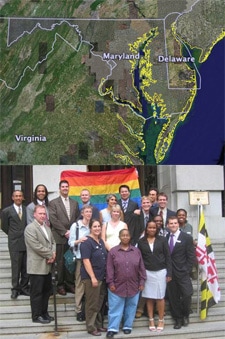
MarylandIn January 2006, Baltimore Circuit Judge M. Brooke Murdock struck down a 1973 state law which defined marriage as between a man and a woman, saying the law was discriminatory and "[could not] withstand constitutional challenge." Murdock added: "When tradition is the guise under which prejudice or animosity hides, it is not a legitimate state interest." The case was brought by nine same-sex couples arguing that the Equal Rights Amendment in Maryland's constitution was discriminatory.

In December 2006, Maryland's highest court heard arguments in the appeal of that decision by the state.

The court issued their ruling today, and upheld Maryland's ban on same-sex marriage.

According to the AP, "Maryland's 1973 ban on gay marriage does not discriminate on the basis of gender and does not deny any fundamental rights, the Court of Appeals ruled. It also said the state has a legitimate interest in promoting opposite-sex marriage. The decision left open the possibility that the Legislature could still take action on the issue. 'Our opinion should by no means be read to imply that the General Assembly may not grant and recognize for homosexual persons civil unions or the right to marry a person of the same sex,' Judge Glenn T. Harrell Jr. wrote for the majority."

You may have missed...
Maryland's Highest Court Hears Gay Marriage Case [tr]

Posted 12:10 PM EST by Andy Towle in Gay Marriage, Gay Rights, Maryland, News | Permalink


Like it?

Subscribe to FREE Towleroad daily headlines with our RSS feed!

... or by Email
RECENT STORIES:

Comments

Feed You can follow this conversation by subscribing to the comment feed for this post.

  1. Those damn activi– Oh, wait.

    Posted by: Tread | Sep 18, 2007 12:03:21 PM


  2. STEPHEN, will be here to tell us how right this decision was in 3, 2, 1...

    He's like a shark when a drop of blood hits the water.

    Anti-marriage equality rulings are like catnip to the man.


    Posted by: Zeke | Sep 18, 2007 12:15:13 PM


  3. "...does not discriminate on the basis of gender and does not deny any fundamental rights."

    That's half right. It discriminates on the basis of sexual orientation (which is fine) and as many closeted gay republicans can tell you, you can get married any old time you want.

    Cowards, hateful bigots, craven vote-seekers.

    Posted by: david s | Sep 18, 2007 12:48:58 PM


  4. Rallies are planned for 6:30 in Glen Dale, MD and Baltimore. Go to equalitymaryland.org for more info.

    Posted by: Greg | Sep 18, 2007 12:50:17 PM


  5. "...does not discriminate on the basis of gender and does not deny any fundamental rights..."

    The only way that anyone could possibly reach this conclusion is if they were blinded by bigotry.

    Posted by: peterparker | Sep 18, 2007 12:53:04 PM


  6. Does anyone know how the court breaks down politically?

    Posted by: anon (gmail.com) | Sep 18, 2007 12:53:41 PM


  7. I sincerely hope that the rallies planned this evening result in a riot the likes of which the East Coast has never seen. And before anyone jumps down my throat for saying that, no, I am not a fan of violence, but I am beginning to believe that violence is the only way we will ever secure our rights.

    Posted by: peterparker | Sep 18, 2007 12:55:30 PM


  8. ANON...here is info on the Maryland Supreme Court Justices:

    Chief Justice Robert Bell...appointed in 1996 by Governor Parris Glendening, a Democrat...his Bio says that as a high school student he participated in sit-ins protesting recially segregated restaurants.

    Irma Steinberg Raker...appointed in 1994 by Governor William Donald Schaefer, a Democratic...I am assuming she is Jewish and would therefore understand the experience of being a minority.

    Dale R Cathell...appointed in 1998 by Governor Parris Glendening, a Democrat..Cathell served in the Air Force...is the former Chair of the Commission on Racial and Ethnic Fairness in the Judicial Process

    Glenn T. Harrell...appointed in 1999 by Governor Parris Glendening, a Democrat.

    Lynne A Battaglia...appointed in 2001 by Governor Parris Glendening, a Democrat

    Clayton Greene, Jr...appointed in 2004 by current Maryland Governor, Robert Ehrlich, a Republican.

    Posted by: peterparker | Sep 18, 2007 1:28:04 PM


  9. Well, isn't that special. And by what numbers did they rule? 6-0?

    Posted by: anon (gmail.com) | Sep 18, 2007 1:46:38 PM


  10. The decision was 4-3 but really the 4 were split into two different camps of two each.

    For a pretty good rundown of the decision and what all was said by whom, visit: http://blog.washingtonpost.com/rawfisher/2007/09/marylands_gay_marriage_ruling.html

    Posted by: Jason | Sep 18, 2007 2:09:57 PM


  11. I get so angry at courts that justify these wrong-headed legal decisions by espousing the State's "legitimate interest in promoting opposite-sex marriage." If I recall correctly, the New York Court of Appeals did the same thing.

    Banning gay marriage has NOTHING to do with promoting opposite-sex marriage, unless what they mean is that the state has a legitimate interest in encouraging gay people to marry opposite sex partners; but somehow I don't think that's what they mean.

    The whole concept that denying rights to one group somehow promotes the rights or behavior of another group is ridiculous. To me it seems like such an obvious leap of logic. They are just trying to craft a "passable" argument to justify a decision that they are making not based on law or logic but on prejudice and bigotry.

    It's dishonest and unfair. This would be dissapointing but more acceptable if it were a legislative decision, or even a decision of the voters; but Justice is supposed to be blind. The courts should be above this. That's their job.

    Shame on the Maryland Court of Appeals. The citizens of Maryland should be embarassed and angry. They deserve much better jurists than these.

    Posted by: darb | Sep 18, 2007 2:20:04 PM


  12. Synonym for bigotry: narrow-mindedness.

    Why is it that people who oppose gay marriage but SUPPORT the benefits that same sex couples seek through a civil union law are always called bigots?

    What about gays who will have it no other way except by obtaining the benefits AND forcing the gay marriage label on their cause? Lighten up and you may realize what you seek. Otherwise, who's being narrow-minded, i.e., the bigot, in this debate?

    Posted by: Stephen | Sep 18, 2007 3:06:59 PM


  13. I'm so disappointed in my state right now.

    Posted by: fangirlhater | Sep 18, 2007 3:08:43 PM


  14. In the 1967 Supreme Court case that ended racial discrimination in marriage, Loving v. Virginia, the Court stated that, "The freedom
    to marry has long been recognized as one of the vital personal rights essential to the orderly pursuit of happiness by free men."
    How then can the Maryland court say that a gay marriage ban, "does not deny any fundamental rights"?

    It took almost 100 years to go from the end of slavery to the end of racial discrimination in marriage. Let's hope it doesn't take that long to end gender discrimination. In time, people will look back at this Maryland decision and be appalled by its bigotry.

    Posted by: gr8guyca | Sep 18, 2007 3:41:22 PM


  15. In the 1967 Supreme Court case that ended racial discrimination in marriage, Loving v. Virginia, the Court stated that, "The freedom
    to marry has long been recognized as one of the vital personal rights essential to the orderly pursuit of happiness by free men."
    How then can the Maryland court say that a gay marriage ban, "does not deny any fundamental rights"?

    It took almost 100 years to go from the end of slavery to the end of racial discrimination in marriage. Let's hope it doesn't take that long to end gender discrimination. In time, people will look back at this Maryland decision and be appalled by its bigotry.

    Posted by: gr8guyca | Sep 18, 2007 3:42:54 PM


  16. I am deeply disappointed but not surprised. My partner and I lived in Maryland and were forced to move when our landlord evicted us for being gay (explicitly stated!). Of course, we fought back in the courts. Unfortunately, we lost. Marylanders talk a good game but do not pass the specific laws that narrow-minded judges require to punish/prevent outright discrimination.

    As for those who tell us to settle for less than full rights and responsibilities, I have no trouble at all labelling you a bigot Stephen, et al. It is not a matter of "lightening up," you imbecile, it is a matter of fundamental respect for my relationship of thirty years, and those of Zeke, RB and others who comment here. That we are told to settle for less than full equality is the marriage equivalent of the separate but equal doctrine (Dred Scott) resounding repudiated in a subsequent decision (Brown v. Board) because separate/lesser is inherently unequal.

    The MD Supreme Court ruling is devastatingly wrong-headed in two respects: (1) Gays are punished for our increasing political power. We do not merit protected class status--in the opinion of the majority--because we have increasing political strength and, therefore, must wait for the legislature to act. (2) The majority found no evidence that being gay is "immutable" therefore, gays cannot be discriminated against because we can change our orientation.

    The majority's opinion if nothing short of a recitation of stupidity and bigotry (yes, I know, that is a redundancy).

    My brothers, I will carry you with me when I protest this horrendous decision this evening. Juntos en la lucha!

    Posted by: rudy | Sep 18, 2007 4:02:24 PM


  17. From Schmtiz Blitz: schmitzblitz.wordpress.com

    I’m not familiar with the intricacies of the Maryland constitution, but I’m going to offer some thoughts on point 3 it relates to the United States constitution (and maybe some of the others in future posts, time permitting).

    The Supreme Court has stated that fundamental rights are “those liberties that are deeply rooted in this Nation’s history and tradition,” and have repeatedly found that marriage is included in the list of fundamental rights. Opponents to marriage equality argue correctly that same sex marriage has never been apart of our nation’s history or tradition.

    Marriage itself, has. Herein lies the distinction. Same sex couples are not asking for the right of some special same sex marriage, they are asking for the right to be included in the preexisting institution of marriage, pure and simple.
    The way that a right is defined plays a huge role in determing if its is in fact a legitimate right or no. The more broadly defined, the more likely it is to fit within tradition, thus being upheld, and vice versa.

    Imagine if this ‘most specific’ methodology had been applied in Loving v. Virginia, which struck down the state’s ban on interracial marriage. Had the Lovings claimed that the right to a mixed race marriage was rooted in our nation’s history and tradition, they would have been instructed to review the long history of America’s antimiscegenation laws. The first antimiscegenation law in North America was enacted in Virginia in 1691. Thirty one states maintained such laws by 1945; sixteen states still held them by the time Loving was decided.

    Further, in Dred Scott v. Sandford, Chief Justice Taney cited the long standing antimiscegenation laws in his decision to deny citizenship to blacks, stating, “intermarriages between white persons and negroes or mulattoes were regarded as unnatural and immoral, and punished as crimes” The Lovings’ claim was upheld, because they called upon the more general right to marry, rather than the specific right to marry someone of a different race, which clearly went against the longstanding traditions of the United States.

    The Loving decision provides an important comparison for those who support same sex marriage. First it establishes that one of the most basic decisions in family life is the decision of whom one chooses to marry. It shows that the right to marry is not limited to longstanding legal or cultural traditions of exclusion. It also provides a framework by which the right of gays to marry should be addressed.

    Just as the Lovings petitioned for, and the courts recognized, the fundamental right to marry, rather than the fundamental right to marry someone of a different race, so too should courts recognize that gays seek the right to marry in the broadest sense, rather than the specific right to marry someone of the same sex.

    All of that being said, though I would have welcomed a decision from the court that recognized the equality of gay families, I respect their restraint. I have said before that I believe decisions involving divisive social issues such as gay equality are better decided by the legislature rather than judges, even if it means the path to equality is slower. I believe the legislature lends an air of legitimacy that the judiciary is largely lost.

    Posted by: Elizabeth Schmitz | Sep 18, 2007 4:14:59 PM


  18. From Schmtiz Blitz: schmitzblitz.wordpress.com

    I’m not familiar with the intricacies of the Maryland constitution, but I’m going to offer some thoughts on point 3 it relates to the United States constitution (and maybe some of the others in future posts, time permitting).

    The Supreme Court has stated that fundamental rights are “those liberties that are deeply rooted in this Nation’s history and tradition,” and have repeatedly found that marriage is included in the list of fundamental rights. Opponents to marriage equality argue correctly that same sex marriage has never been apart of our nation’s history or tradition.

    Marriage itself, has. Herein lies the distinction. Same sex couples are not asking for the right of some special same sex marriage, they are asking for the right to be included in the preexisting institution of marriage, pure and simple.
    The way that a right is defined plays a huge role in determing if its is in fact a legitimate right or no. The more broadly defined, the more likely it is to fit within tradition, thus being upheld, and vice versa.

    Imagine if this ‘most specific’ methodology had been applied in Loving v. Virginia, which struck down the state’s ban on interracial marriage. Had the Lovings claimed that the right to a mixed race marriage was rooted in our nation’s history and tradition, they would have been instructed to review the long history of America’s antimiscegenation laws. The first antimiscegenation law in North America was enacted in Virginia in 1691. Thirty one states maintained such laws by 1945; sixteen states still held them by the time Loving was decided.

    Further, in Dred Scott v. Sandford, Chief Justice Taney cited the long standing antimiscegenation laws in his decision to deny citizenship to blacks, stating, “intermarriages between white persons and negroes or mulattoes were regarded as unnatural and immoral, and punished as crimes” The Lovings’ claim was upheld, because they called upon the more general right to marry, rather than the specific right to marry someone of a different race, which clearly went against the longstanding traditions of the United States.

    The Loving decision provides an important comparison for those who support same sex marriage. First it establishes that one of the most basic decisions in family life is the decision of whom one chooses to marry. It shows that the right to marry is not limited to longstanding legal or cultural traditions of exclusion. It also provides a framework by which the right of gays to marry should be addressed.

    Just as the Lovings petitioned for, and the courts recognized, the fundamental right to marry, rather than the fundamental right to marry someone of a different race, so too should courts recognize that gays seek the right to marry in the broadest sense, rather than the specific right to marry someone of the same sex.

    All of that being said, though I would have welcomed a decision from the court that recognized the equality of gay families, I respect their restraint. I have said before that I believe decisions involving divisive social issues such as gay equality are better decided by the legislature rather than judges, even if it means the path to equality is slower. I believe the legislature lends an air of legitimacy that the judiciary is largely lost.

    Posted by: Elizabeth Schmitz | Sep 18, 2007 4:15:08 PM


  19. Stephen,

    If you tone down the rhetoric, your arguments may be more effective.

    Whether or not someone who supports civil unions but not marriage is a "bigot" depends entirely on their reasons for taking that position. I don't think that those people are "always" called bigots.

    Also, while I understand (but don't agree with) your pragmatic approach to the marriage debate (i.e., its the rights that are important, not the label), I have a hard time imagining how anyone who is striving for full marriage equality (label and all) could, based on that, be described as a "bigot."

    Posted by: darb | Sep 18, 2007 4:19:35 PM


  20. Elizabeth

    I disagree. I don't think that the court showed restraint, I think that it showed cowardice and abdication of their role as a check against the legislative branch's vulnerability to public opinion.

    One of the most important roles of the judiciary is to protect those in the minority from the "tyranny of the majority". So even if the people or the legistlature of the state of Virginia were not ready, in 1967, for inter-racial marriages, it was the job of a courageous court to override this majority opinion in favor of constitutional principles.

    I wish the Maryland court had the courage to do their job and apply those principles today.

    Posted by: darb | Sep 18, 2007 4:26:36 PM


  21. I know I am being narrow-minded here, but I really don't think that gay people are worth it. I mean, apparently, neither does the Maryland Supreme Court. Nor Saudia Arabia; nor the Sudan. I like God and all, but sometimes I wonder how a Christian nation like the United States can even have this debate. We should be more like Iran, where they lynch homosexuals so that they can't try to sue in court to get married.

    Posted by: Stephen | Sep 18, 2007 5:08:43 PM


  22. Rudy: It was Plessy v Ferguson that was reversed by Brown v Board et al, not Dred Scott. Dred Scott was reversed the 14th amendment.

    Posted by: anon (gmail.com) | Sep 18, 2007 5:25:26 PM


  23. I'm glad Stephen finally posted. I was worried he was passed out in his home choking on a ham sandwich or something.

    Posted by: db | Sep 18, 2007 5:47:22 PM


  24. ANON (strange how it is always anon), Go read the opinions (perhaps for the first time?) I tried e-mailing you directly but it was returned as "undeliverable". Maybe you do not even exist as 'anon'.

    In any event, I am off to the protest. Try ANON to make productive use of your time.

    Posted by: rudy | Sep 18, 2007 5:50:42 PM


  25. God's speed RUDY my friend!

    WELCOME BACK!!!

    ANON, you are right but it doesn't negate what RUDY correctly stated with respect to B v. BoE and Dred Scott.

    Darb, FYI, Stephen is not gay and he is not fighting FOR any form of relationship recognition for gay and lesbian people. He is a Focus on the Family troll who only comes to Towleroad when ANDY posts a story about a developement in the marriage equality fight, to repeat the FOF talking points. He's like clockwork. That's why I posted the "Stephen in 3,2,1..." comment above.

    If you have any questions about what he is about I can direct you to archived comments by him where he says some very unkind things about "homosexuals". I can also show you comments that he made where he demeaned and degraded my 16 year relationship with my husband and called our son "illegitimate" and "unnatural".

    Don't waste your time trying to reason with him. He doesn't debate from a position of reason.

    Posted by: Zeke | Sep 18, 2007 6:25:19 PM


Post a comment


Lijit Search


« «Florida Rep. Bob Allen to Request Postponement of Trial« «