03/02/2007
Out of this World: Cassini Sends Postcards from Saturn
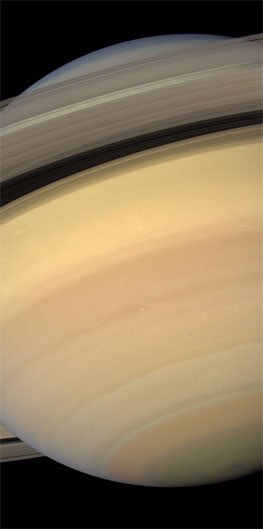
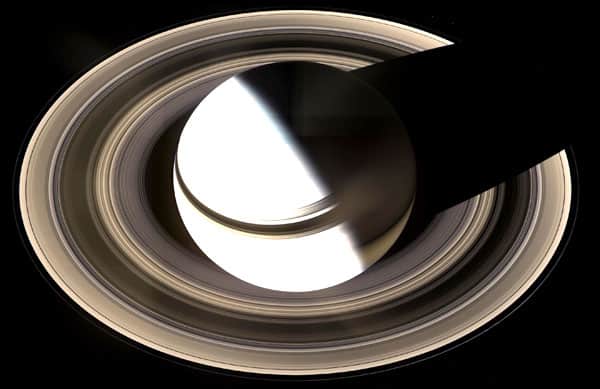
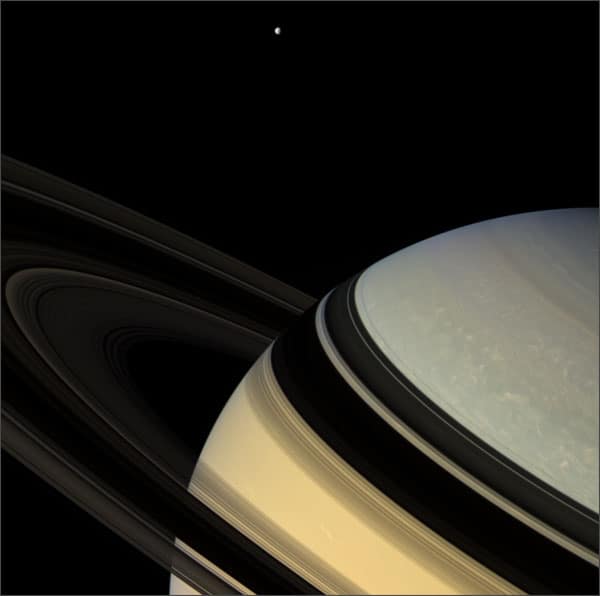
The $3.3-billion U.S. Cassini mission, funded by NASA and the European and Italian space agencies, recently sent back these stunning images the Cassini craft snapped while in an inclined orbit around the planet Saturn over the past two months.
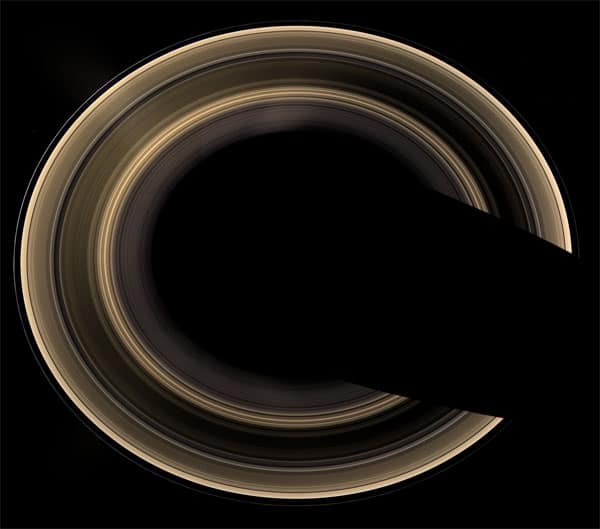
The Cassini mission is the most comprehensive imaging project of a body in the outer solar system ever undertaken. Upon release of these recent photos, more of which can be seen here, Cassini scientist Carolyn Porco said, "Finally, here are the views that we've waited years for. Sailing high above Saturn and seeing the rings spread out beneath us like a giant, copper medallion is like exploring an alien world we've never seen before. It just doesn't look like the same place. It's so utterly breath-taking it almost gives you vertigo."
The short film below, also just released, shows a ringplane crossing, made by Cassini twice every orbit. What you are seeing is the view from the spacecraft as it moves from the sunlit to the unlit side of the rings. For a full appreciation of the film, in which two of Saturn's largest moons can also be seen, follow the jump.
Yeah, I'm a space geek.
From NASA's Cassini Imaging Diary:
"This life-like movie sequence captures Saturn's rings during a ringplane crossing -- which Cassini makes twice per orbit -- from the spacecraft’s point of view. The movie begins with a view of the sunlit side of the rings. As the spacecraft speeds from south to north, the rings appear to tilt downward and collapse to a thin plane, and then open again to reveal the unilluminated side of the ringplane, where sunlight filters through only dimly.
The striking contrast between the sunlit and unlit sides of the ringplane can now be fully appreciated, thanks to the sense of continuity in time and space provided by this brief clip.
The movie consists of 34 images taken over the course of 12 hours as Cassini pierced the ringplane. Additional frames were inserted between the original images in order to smooth the motion in the sequence -- a scheme called interpolation.
Six moons careen through the field of view during the sequence. The first large one is Enceladus, whose slanted motion from upper left to center right nicely illustrates the inclination of its orbit with respect to the rings. The second large one, seen in the second half of the movie, is Mimas, going from right to left.
This movie begins with a view looking toward the lit side of the rings from about 9 degrees below the ringplane. It ends when the spacecraft is 8 degrees above the ringplane.
The clear filter images in this movie sequence were taken with the Cassini spacecraft wide-angle camera on Jan. 17, 2007 at a distance of approximately 900,000 kilometers (500,000 miles) from Saturn. Image scale is 48 kilometers (30 miles) per pixel."
You may have missed...
Comet McNaught Makes an Appearance [tr]
From a Distance: Massachusetts from Space [tr]
Space Porn: Atlantis Moments after Intercourse [tr]
Posted 9:40 AM EST by Andy Towle in News, Photography, Space | Permalink
Like it?
Subscribe to FREE Towleroad daily headlines with our RSS feed!
RECENT STORIES:
Comments
You can follow this conversation by subscribing to the comment feed for this post.


Amazing. Simply amazing.
Posted by: Brian | Mar 2, 2007 9:53:53 AM
Right on, Andy... one space geek to another. You totally scored...!
Posted by: No Name East | Mar 2, 2007 10:02:31 AM
Awesome! And you say Space Geek like its a bad thing. :)
Posted by: Ed | Mar 2, 2007 10:40:57 AM
Andy, make no apologies for being a geek of the space variety. If someone doesn't appreciate the cool pics you always share with them, well then f*@# them. ;-)
Posted by: EricW | Mar 2, 2007 11:24:17 AM
Andy, where can I get high-res copies of those images? I'd like one of them to be my desktop wallpaper lol... seriously.
Posted by: Cory | Mar 2, 2007 11:27:54 AM
Eh.
Could use a soundtrack. (hint, Andy) :)
Posted by: Alan | Mar 2, 2007 11:38:11 AM
Cory, check out the Cassini site that I link to...
Posted by: andy | Mar 2, 2007 11:46:50 AM
i'm never into "out of this world" US spending (ie: iraq) when so much is ill within America (ie: louisiana) unless it's for space and NASA... then i'm totally thumbs-up !!
gorge post Andy.
Posted by: A.J. | Mar 2, 2007 12:13:36 PM
TOWLEROAD GEEKS UNITE!!
I came out of the closet as a geek a few years back and never felt prouder.
Geeks run the world.
Posted by: mark m | Mar 2, 2007 12:44:12 PM
"Yeah, I'm a space geek"... join the club! Nothing wrong with that! That video is just f-ing amazing, just wonderful.
Posted by: virgoboy | Mar 2, 2007 12:49:25 PM
wow! very cool!
(cool enough to make me post for the first time!)
Posted by: gabriel | Mar 2, 2007 1:18:21 PM
Go Space Geeks!!!
Posted by: MikEM | Mar 2, 2007 1:18:22 PM
To those who say "there must be more to life than this!" Well look at what "this" is! Who needs an afterlife; the beauty of the universe is self-evident. The images on the NASA-ESA site are breathtaking.. it makes you feel small, in a good way. http://www.spacetelescope.org/
Posted by: atheist | Mar 2, 2007 1:56:57 PM
Nice! Though why does the satellite go from right to left in the second half?? It looks like the "film" is running backwards.
It took my parents a long time to get over my being a geek, they fretted constantly about never getting any grandkids out of me.
Posted by: anon | Mar 2, 2007 2:44:50 PM
Those pics of Saturn are just incredible.
Posted by: Ron | Mar 2, 2007 2:57:52 PM
For 3.3 billion dollars I would think they would've at least loaded the camera with color film! Sheesh!
Posted by: peterparker | Mar 2, 2007 3:05:20 PM
Anon,
I think perhaps because the moon is orbiting, so at first it passes left to right and then as it comes around the far side of Saturn, it passes right to left.
Just a guess since I only viewed it once.
Posted by: mark m | Mar 2, 2007 3:55:55 PM
it's really awesome!!
Posted by: sickboii | Mar 3, 2007 12:38:57 AM
Wow that is amazing. At first as I watched the film it thought that it was a CGI rendering (forgot to read the whole paragraph). Truly it is wonderful to see out into space. I have been a space geek for most of my life (a long and arduous 20 years...) and it is nice to know that there are other gay geeks out there. I guess in my neck of the woods we are an endangered species lol.
Posted by: Nick | Mar 3, 2007 9:00:40 PM
To Anon and Mark M.:
Read the NASA description of the film more carefully:
> Six moons careen through the field of
> view during the sequence. The first large
> one is Enceladus, whose slanted motion
> from upper left to center right nicely
> illustrates the inclination of its orbit
> with respect to the rings. The second
> large one, seen in the second half of
> the movie, is Mimas, going from right
> to left.
So the first satellite you see is Enceladus, and then later the second satellite you see going in the opposite direction is Mimas.
... When I was in high school I saw the movie "2001: A Space Odessey" and wondered if I would ever get the chance to see what the *real* Jupiter looked like --- as opposed to the mocked-up Jupiter that Kubrick created.
Now I've lived to see a similar movie made of the *real* Saturn! And I didn't even have to get frozen like Walt Disney!
Posted by: Allen | Mar 3, 2007 10:26:40 PM
Search for in all major search engines simultaneously on the site http://www.iknowall.com.
Simultaneous search on Google, Yahoo and MSN Live Search.
Try http://www.iknowall.com
Posted by: iknowall | Jun 1, 2007 3:50:14 PM